


Most Business Cases are built around one thing: winning more clients. But your partners aren’t just looking at your revenue ambitions. They’re looking at whether you think commercially; whether you understand margin, efficiency, and what it takes to build something sustainable.
This episode shows you why growing your practice profitably often means improving what you already have before you go after new work. And walks through the maths that proves two small changes can increase your profit by 22.5% without a single new client.
If your Business Case reads like a revenue wish list rather than a commercial argument, this episode is for you.
In This Episode You Will Learn:
- Why a Business Case built only on winning new work tells your partners you think like a fee earner, and what commercial thinking actually looks like
- The maths behind a 22.5% profit increase from two small changes to margin and billing volume, with no new clients required
- How Jessica built a stronger partnership case than most by focusing on profitability in year one before growth in years two and three
- Why your Business Case needs to show how the practice grows beyond your own hours
If you find this episode useful, don’t forget to like it and then subscribe so you don’t miss another episode.
What Help Is Out There For You?
If you’re thinking, ‘I understand the principle, but I’m not sure how to build the commercial argument in a way that holds up under scrutiny,’ our Progress To Partner Academy can help you.
That’s precisely why we have the on-demand course ‘How to Create a Cast-Iron Business Case for Partner’ in the Progress to Partner Academy. It walks you through how to build the financial narrative for your Business Case — including how to think about margin, resourcing, and sustainable growth — using the STAGe model.
You can also listen to this episode on Substack and on Apple Podcasts
Hello, and welcome!
What if I told you that you could increase the profit in your practice by 22.5% without winning a single new client?
No new business development. No networking events. No pitches. Just two small changes to what you’re already doing.
I’m going to show you the maths in this episode. Because understanding this is the difference between a Business Case that reads like a revenue wish list and one that reads like a commercial argument. And your partners know the difference.
This is the How to Make Partner podcast with me, Heather Townsend. The author of Poised for Partnership, and co-author of How to Make Partner and Still Have a Life. In this podcast, I will be highlighting some of the great stuff in our Progress To Partner Academy. New episodes are released weekly, so press subscribe so you never miss a new episode.
Right, let’s talk about what your partners are actually looking for when they read your Business Case.
When a partnership reviews a Business Case, one of the things they’re assessing is whether the person in front of them thinks commercially. Not just whether they can win work. But whether they understand how a profitable practice actually works. And one of the fastest ways to fail that test is to write a Business Case that is entirely about revenue, with no thought given to margin, efficiency, or how the practice sustains itself over time.
Your role is not to grow a practice. It’s to grow a profitable and sustainable practice that supports the firm’s overall strategy. That distinction matters. A lot.
So let’s look at the maths. And I want to be clear, this isn’t complicated. You don’t need a finance degree to follow this.
Let’s say you billed £200,000 last year at a gross profit margin of 30%. That gives you a gross profit of £60,000.
Now. Two small changes.
First, you implement a modest price increase and look at how the work is resourced, so your margin moves from 30% to 35%. You haven’t won any new work. You’ve just made the existing work more profitable. Your profit on £200,000 billing is now £70,000. That’s £10,000 more than before.
Second, you streamline your delivery processes enough to bill 5% more with the same team. So now you’re billing £210,000 rather than £200,000, and you’re holding that improved margin of 35%. Your gross profit is now £73,500.
That’s an increase from £60,000 to £73,500 in gross profit. A 22.5% increase. From two changes, neither of which required you to go out and find a single new client.
Here’s the point. That’s commercial thinking. And that’s what your partners want to see evidence of in your Business Case.
I worked with someone called Jessica who understood this instinctively. She was stepping into the role of a retiring partner. The easy thing to do would have been to write a Business Case that was all about how she’d maintain the revenue and grow from there. That’s what most people would have done.
Instead, Jessica spent time before writing a word of her Business Case looking at how the retiring partner ran the practice. She identified areas where she could handle the work more efficiently for example better project management, clearer processes, more appropriate resourcing. The kind of changes that would let her handle the same volume of work at a higher margin than her predecessor.
So her Business Case didn’t just say: I will maintain the practice and then grow it. It said: in year one, I will hold the revenue while increasing profitability significantly. In years two and three, I will grow from that more profitable base. It was a fundamentally different argument, and a much stronger one. Her commercial and well-considered approach was one of the reasons she made partner.
Now, there’s a second dimension to this that catches people out, and it’s the issue of time. Many Business Cases are written on the assumption that the person will simply keep winning more and more work. But your time is finite. If you’re already billing eight hours a day and catching up on admin at weekends, there isn’t much room to just add more.
This is why your Business Case needs to show not just what you will do, but how the practice grows beyond you.
What resource will you need? How will you build the team to deliver on the revenue and profit goals you’re promising? Because your partners aren’t just backing your personal effort. They’re backing a practice — and a practice needs to be able to run without depending entirely on one person’s hours.
Here’s the key message: the partners reading your Business Case are looking for evidence of commercial thinking. Show them you understand that growth comes from more than just winning more work. Show them you’ve thought about margin, efficiency, resourcing, and sustainability. That’s what separates a Business Case that reads like a wish list from one that reads like a plan.
A Business Case built only on winning new work is a Business Case that tells your partners you think like a fee earner. One that addresses margin, efficiency, resourcing, and sustainability tells them you think like a partner. The difference isn’t just in the numbers, it’s in how you’re seen.
Now, if you’re thinking, ‘I get the principle, but I’m not sure how to put the commercial argument together in a way that actually holds up under scrutiny,’ that’s exactly what our How to Create a Cast-Iron Business Case for Partner course in our Progress To Partner Academy is designed for. It walks you through how to build the financial narrative for your Business Case — including how to think about margin, resourcing, and sustainable growth — using the STAGe model.
I’ve popped a link to our Progress To Partner Academy directly in the show notes for this episode. Also in the show notes, you’ll find links to my books — Poised for Partnership and How to Make Partner and Still Have a Life — so you can easily find them on Amazon. And as a thank you for listening, there’s also a link for a 10% discount on annual membership for our Progress To Partner Academy using the code PODCAST10.
That’s all for this episode of the How to Make Partner podcast. What’s your action for this week?
Run the maths on your own practice. Take your current billings and your estimated gross margin, and work out what a 5% improvement in margin and a 5% improvement in billing volume would do to your profit. Write the number down. Then ask yourself: is that argument in your Business Case? If not, that’s a good place to explore.
If you have enjoyed this episode please leave us a review on Spotify or Apple Podcasts or give us a comment on Substack. This helps us get the word out to others who may need this advice too.
Remember to hit subscribe so you don’t miss next week’s episode. Thanks for listening
About Progress To Partner Academy: On-demand career help and guidance
You have to drive your career forwards. Your firm wouldn’t do that for you.
Stop waiting to be noticed for career development courses by your firm.
Make the firm notice you! You will get the skills and knowledge about what the partners are really looking for when you join our Progress to Partner Academy.
In our Progress To Partner Academy you’ll find our popular courses:
– How to delegate like a pro
– How to lead a hybrid team
– How to excel as a line manager
Join our Progress To Partner Academy and use the code PODCAST10 to get 10% off 12 months of premium annual membership.
Links
Complete my FREE Partnership Readiness Assessment – to see where you have gaps in your own development – you’ll get a personalised report with actions for what progress your career forward
Connect with me on LinkedIn
Join Progress To Partner Academy and use the code PODCAST10 to get 10% off 12 months of premium annual membership.
Buy your hard copy of Poised for Partnership or buy the Ebook here
Buy your copy of How To Make Partner And Still Have A Life
Buy your copy of The Go To Expert
Buy your copy of The Financial Times Guide To Business Networking
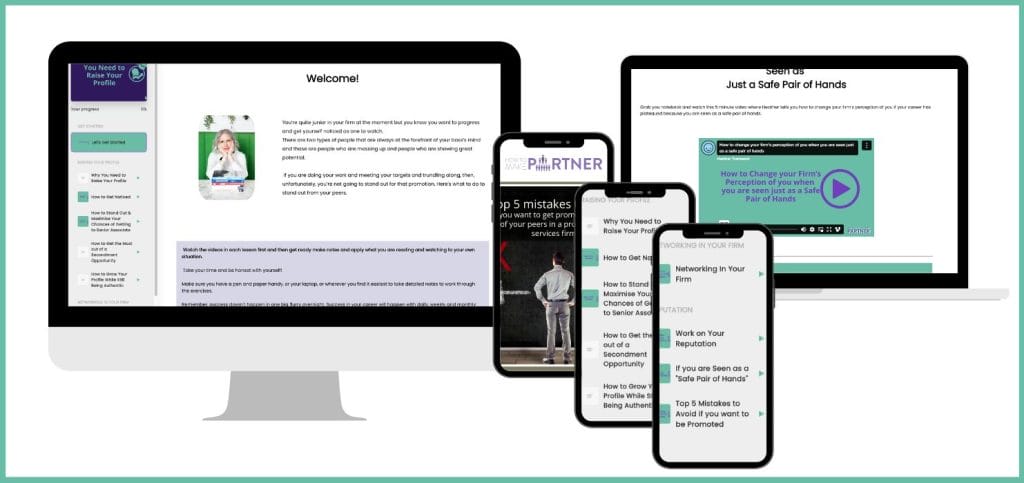
Join my Progress To Partner Academy and access all my courses and use the code PODCASTBP10 to get 10% off 12 months of premium annual membership.
______________________________________
More help to progress your career in your law, accountancy or consulting firm?
- Sign up to my weekly tips packed full of advice and knowledge on how to progress your career in your professional service firm – click here!


