


Imagine you’ve decided it’s time to have “the conversation” about your partnership ambitions. You book time with a senior partner in your firm. The meeting goes well. You feel energised.
Then, a few days later, you sense something’s off with your direct line manager. The atmosphere has changed. They seem cool with you.
What happened? You just committed one of the cardinal sins of partnership politics: you went to the wrong person first.
This political misstep might have just damaged your partnership chances more than any weakness in your Business Case.
The unwritten rule: always go to your direct line manager first. Not the senior partner you once worked with. Not the office managing partner. Not the influential partner you met at a networking event. Your direct line manager. Always.
In this episode, you’ll discover the political rules of partnership conversations that no one tells you about, but everyone expects you to know.
In this episode you will learn:
- The golden rule of partnership conversations (and why breaking it can damage critical relationships)
- Why your direct line manager needs to be your first conversation (and how going over their head signals you don’t value them)
- How different partners have different agendas (and why the office managing partner cares about different things than your practice group leader)
- How to ask for partnership conversations without creating political problems (the exact language to use)
If you find this episode useful, don’t forget to like it and then subscribe so you don’t miss another episode.
What help is out there for you to progress your career in the professions?
If you’re thinking, ‘I understand this intellectually, but I genuinely struggle with self-belief and need help changing the story I’m telling myself’, our Progress To Partner Academy has resources specifically designed for this.
We have recorded masterclasses on overcoming imposter syndrome and changing your firm’s perception of you. Our on-demand course “How to Truly Commit to Moving Your Career Forward” includes modules on building the courage to take action even when you’re uncertain, with exercises that help you reframe your internal narrative.
If you’re unsure where to start, take our free Partnership Readiness Assessment. It takes 12 minutes and shows exactly which key indicators to focus on – often just knowing specifically what to work on helps close the confidence gap.
You can also listen to this episode on Substack and on Apple Podcasts
Imagine you’ve decided it’s time to have “the conversation” about your ambition to make partner. You’ve been working on your Business Case, you know you’re close, and you want feedback from influential partners. So you book time with a senior partner in your firm.
The meeting goes well. You get great advice. You feel energised. But then, a few days later, you sense something’s off with your direct line manager. The atmosphere has changed. They seem… cool with you.
What happened?
You just committed one of the cardinal sins of partnership politics: you went to the wrong person first. And that political misstep might have just damaged your partnership chances more than any weakness in your Business Case.
Today, we’re talking about the unwritten political rules of partnership conversations – the ones that no one tells you about, but everyone expects you to know.
This is the How to Make Partner podcast with me, Heather Townsend. The author of Poised for Partnership, and co-author of How to Make Partner and Still Have a Life. In this podcast, I will be highlighting some of the great stuff in our Progress To Partner Academy. New episodes are released weekly, so press subscribe so you never miss a new episode.
Right, let’s navigate these political waters. I recently hosted a panel with partners from a global firm, and we had a really illuminating discussion about the politics of who you approach and when.
One of the senior partners on the panel shared a story from his own experience. Going back a bit, he had people come to him to ask about their career before they’d gone to their local leader or direct manager first.
Without having that conversation locally first, it didn’t land well with that person. It would sometimes cause friction.
His key point: “We kind of got over it, but… trying to be politically clever is one thing, but remember where your bread is buttered. Go to probably the most natural place first and foremost.”
He gave a specific example: “If your direct reporting line is me and Raj sits above me, conceptually you should probably come to me first, have a conversation, then maybe say, ‘I’d also like to take Raj’s view,’ and I would say, ‘Of course, go for it.’ But if you’d gone straight to Raj and excluded me, people can take that sometimes not quite in the best way.”
This is the political reality that no one writes in the partnership handbook, but it’s absolutely critical to understand.
The golden rule
Here’s the golden rule: unless you have a very good reason not to, your first conversation about partnership should always be with your direct line manager.
Always.
Not the senior partner you once worked with. Not the office managing partner. Not the influential partner you met at a networking event. Your direct line manager.
Why? Several reasons that all matter.
First, they’re likely to be your biggest advocate in partnership discussions. When your name comes up, they’ll be asked their opinion. You want them informed and supportive, not surprised and offended.
Second, they have the most direct knowledge of your work. They know your strengths, your gaps, and what you need to demonstrate. Their feedback will be the most relevant.
Third, going over their head signals you don’t value or trust them. Even if that’s not your intention, that’s how it lands. And in Chapter 10 of Poised for Partnership, I talk about how at this stage of your career, it’s less about your technical excellence and more about who you know and how they view you.
Fourth, they’ll hear about your ambitions eventually. Would you rather they hear it from you in a thoughtful conversation, or hear it second-hand from someone else?
How to have that first conversation
So what does that conversation with your direct line look like?
You book time with them. Fifteen, twenty minutes. And you say something like: “I wanted to talk to you about my partnership ambitions. I’ve been thinking about my timeline and my Business Case. I’d really value your honest assessment of where I am and what gaps you see.”
Then you listen. Really listen. They might tell you things you don’t want to hear. That’s fine. You need to know.
Then you ask: “Who else do you think I should be speaking with? I’d like to get perspectives from a few people, but I wanted to start with you.”
Notice what you’ve done there. You’ve made them feel valued. You’ve asked for their advice. You’ve positioned them as your starting point, not someone you had to tick off a list.
Nine times out of ten, they’ll say something like: “You should definitely talk to the office managing partner. And probably . Let me know how those conversations go.”
Now you’ve got permission. Now you can have those other conversations without creating political problems.
Understanding different agendas
Here’s something else the panel made very clear: different partners have different agendas when you talk to them about partnership. And you need to be aware of this.
Your office managing partner wants you to be a great firm citizen because that helps their office thrive. So they’ll focus on whether you’re contributing to office culture, whether you’re collaborative, whether you’re someone who makes the office better.
Your practice group leader wants you to build a strong practice that enhances the practice group’s reputation and profitability. So they’ll focus on your technical excellence, your client relationships, your ability to win work.
The partnership selection committee wants to make sure you’re truly ready and won’t damage the partnership’s reputation or financial stability. So they’ll focus on your Business Case, your financial performance, whether you can really sustain a partnership-level practice.
None of these agendas are wrong. But they’re different. And if you understand what each person cares about, you can have more productive conversations with them.
Tailoring your approach
One of the partners on the panel made another great point about tailoring your approach to the person.
He said: “Think ahead of time about how well you know this person you’re going to talk to. If you know them reasonably well, like a partner you see most days, that’s one type of conversation. But if your practice group leader is in a different office or time zone, that’s going to be a different conversation.”
He continued: “If you do know them reasonably well, then tailor your approach to what they are like. Know your audience. Some people are going to want reams of detail. They’re going to want spreadsheets, Excel files full of numbers about your plan. And other people are going to be a lot more vibes-based and are going to want something much higher level, much more feel-based.”
His key point: “It’s not that one of those is right and one of those is wrong. People are just different and you need to tailor your approach to what they are like.”
If you’re dealing with someone who is really into detail and financials, you need to be prepared to talk about that. If they catch you out because you aren’t on top of those details, that conversation probably hasn’t gone the way you would hope.
How to ask for the conversation
So how do you actually ask for these conversations?
If you’ve got a personal relationship with someone you’ve worked with, pick up the phone or pop into their office and say, “Could we arrange something? I’d like to get your perspective on my partnership plans.”
If it’s someone you know less well, a quick email or message works. Something like: “This is where I am in my career. I’d really appreciate 15-20 minutes over a coffee or on Teams just to explore a few things and get your perspective.”
Most partners will receive that well. Everyone is time-poor, but when people in their team are coming to them asking for support and trying to get to the next stage, they’re all ears for that because it shows maturity.
One partner on the panel pointed out that doing these conversations also helps raise your profile within the firm. Sometimes talking to someone outside your immediate team can be really valuable for getting a different perspective and building broader support.
But always, always start with your direct line first.
The politics of partnership conversations aren’t about being manipulative or playing games. They’re about respecting relationships and being thoughtful about how you navigate your path to partnership. Get this right, and you’ll build a strong network of advocates. Get it wrong, and you might damage relationships that are critical to your success.
The golden rule is simple: go to your direct line first. Get their support. Ask for their advice on who else to talk to. Then have those other conversations with their knowledge and blessing.
Now, if you’re thinking, “This is really helpful, but I’d like more support understanding the political dynamics in my specific firm and how to navigate them,” that’s exactly what we cover in the Progress To Partner Academy. We help you map out the political landscape and develop a strategy for building your internal support.
If you’re unsure where you stand or what gaps you need to address before having these conversations, start with our free Partnership Readiness Assessment. It takes about 12 minutes and gives you an instant report showing exactly which key indicators you need to focus on. This will help you have more informed conversations with your partners.
I’ve popped a link to the Partnership Readiness Assessment and our Progress To Partner Academy directly in the show notes for this episode. Also in the show notes, you’ll find links to my books – Poised for Partnership and How to Make Partner and Still Have a Life – so you can easily find them on Amazon. And as a thank you for listening, there’s also a link for a 10% discount on annual membership for our Progress To Partner Academy using the code PODCAST10.
That’s all for this episode of the How to Make Partner podcast. What’s your action for this week?
If you haven’t had a conversation with your direct line manager about your partnership ambitions, schedule it this week. Don’t wait. Don’t go to other partners first. Start with your direct line. That’s the golden rule.
If you have enjoyed this episode please leave us a review on Spotify or Apple Podcasts or give us a comment on Substack. This helps us get the word out to others who may need this advice too. Remember to hit subscribe so you don’t miss next week’s episode. Thanks for listening!
About Progress To Partner Academy: On-demand career help and guidance
You have to drive your career forwards. Your firm wouldn’t do that for you.
Stop waiting to be noticed for career development courses by your firm.
Make the firm notice you! You will get the skills and knowledge about what the partners are really looking for when you join our Progress to Partner Academy.
In our Progress To Partner Academy you’ll find our popular courses:
– How to delegate like a pro
– How to lead a hybrid team
– How to excel as a line manager
Join our Progress To Partner Academy and use the code PODCAST10 to get 10% off 12 months of premium annual membership.
Links
Complete my FREE Partnership Readiness Assessment – to see where you have gaps in your own development – you’ll get a personalised report with actions for what progress your career forward
Connect with me on LinkedIn
Join Progress To Partner Academy and use the code PODCAST10 to get 10% off 12 months of premium annual membership.
Buy your hard copy of Poised for Partnership or buy the Ebook here
Buy your copy of How To Make Partner And Still Have A Life
Buy your copy of The Go To Expert
Buy your copy of The Financial Times Guide To Business Networking
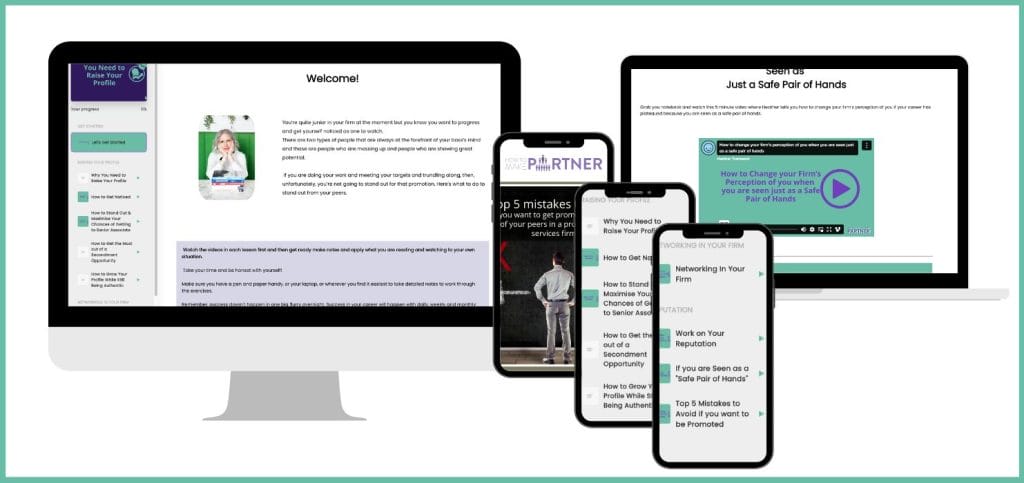
Join my Progress To Partner Academy and access all my courses and use the code PODCASTBP10 to get 10% off 12 months of premium annual membership.
______________________________________
More help to progress your career in your law, accountancy or consulting firm?
- Sign up to my weekly tips packed full of advice and knowledge on how to progress your career in your professional service firm – click here!


