


You’ve been working on your Business Case for months, maybe years. You know you need to start talking to partners about your partnership ambitions and getting their buy-in.
But here’s the problem: How do you actually have that conversation without coming across as presumptuous, pushy, or desperate?
Do you prepare a full presentation deck? A written Business Plan? Treat it like a formal pitch? Or keep it casual over coffee?
Here’s what experienced partners say: don’t over-prepare. This is a conversation, not a presentation. You’re asking for advice and perspective, not delivering a sales pitch.
But there’s a tension: you can’t walk in completely unprepared either. You need to be able to talk intelligently and naturally about your practice without reading from slides.
In this episode, you’ll discover how to socialise your Business Case in a way that positions you as ready for partnership – without sounding desperate or rehearsed.
In this episode you will learn:
- Why over-preparing with PowerPoint decks actually hurts your chances (and what to do instead)
- How to summarise your Business Case in 1-3 sentences that sound natural, not rehearsed
- The question that flips the conversation and makes partners want to help you (instead of you trying to convince them)
- A real example of how someone killed their partnership conversation with a 40-slide deck (and what they should have done instead)
If you find this episode useful, don’t forget to like it and then subscribe so you don’t miss another episode.
What help is out there for you to progress your career in the professions?
If you’re thinking, ‘I get the theory, but I need help developing my business case narrative and preparing for these conversations’, our Progress To Partner Academy can help you.
That’s precisely why we have a course in the Progress to Partner Academy called “How to Create a Cast-Iron Business Case for Partner”. It takes you through step-by-step how to develop your narrative, prepare your evidence, and have these crucial conversations with confidence.
If you’re unsure where to start, take our free Partnership Readiness Assessment. It takes 12 minutes and shows exactly which key indicators to focus on – often just knowing specifically what to work on helps close the confidence gap.
You can also listen to this episode on Substack and on Apple Podcasts
Hello, and welcome!
You’ve been working on your Business Case for months, maybe years. You’ve identified your niche, you’ve got some clients, you’re building a practice. You know you need to start talking to partners about your partnership ambitions and getting their buy-in to your plans.
But here’s the problem: How do you actually have that conversation?
Do you prepare a full presentation deck? Do you bring a written Business Plan? Do you treat it like a formal pitch? Or should it be more casual – just a chat over coffee?
And here’s the bigger fear: How do you socialise your Business Case and career ambitions without coming across as presumptuous, pushy, or worse – desperate?
Today, we’re solving this puzzle. I’m going to share the exact framework for how to approach partners about your career progression in a way that positions you as commercial, mature, and ready for partnership.
This is the How to Make Partner podcast with me, Heather Townsend. The author of Poised for Partnership, and co-author of How to Make Partner and Still Have a Life. In this podcast, I will be highlighting some of the great stuff in our Progress To Partner Academy. New episodes are released weekly, so press subscribe so you never miss a new episode.
Right, let’s talk about how to have these conversations without over-engineering them.
I recently posed this question to a panel of experienced partners: “You’re preparing for a meeting with your office managing partner or practice group leader about your partnership prospects. What key things would you put in your agenda for that conversation? And what should you have prepared?”
The first partner’s answer surprised people. He said: “I don’t think you need to overprepare. I think it needs to be an open conversation. I wouldn’t treat it as a sales pitch personally.”
He explained that if you arrive and go, “Right, okay, so I just want to let you know that for the last 3 years, my utilisation has been this and I’ve got this…” – that’s not the right approach. That feels like you’ve been to see a coach, you’ve learned your lines, and you’re delivering them. The partner feels like they’re being blindsided with a pitch.
Instead, he said, “The conversation is more like, ‘You know me, you know my strengths and weaknesses. What do you think would be…’ – that’s my starting point if you know them reasonably well.”
And if you don’t know them that well, you can say, “What are the key things that you’re looking for to support me in making partner?”
The key message: this is a conversation, not a presentation. You’re asking for advice and perspective, not delivering a sales pitch.
But you still need to be prepared
Now, here’s the tension. You don’t want to overprepare and deliver a rehearsed pitch. But you also can’t walk in completely unprepared.
Another partner made this point brilliantly: “If you’re at the level that believes it is ready for partnership and you can’t talk about – with your partners – what you do, what your practice is, what you’re aiming to achieve… you probably shouldn’t be in this conversation.”
That sounds harsh, but actually it’s liberating. You don’t need PowerPoint slides or a 50-page document. You just need to be able to talk intelligently and naturally about your work.
So what does that actually mean?
Your narrative needs to be in your head, not on slides
You need to be able to summarise your Business Case in one to three sentences. In Chapter 11 of Poised for Partnership, I talk about developing your “one-sentence sell” and “three-sentence sell” for partnership.
For example, you might say: “I’ve grown our work with retail clients by £200,000 over the last two years. My internal network has built a pipeline of another £500,000 of work. And the credentials we’re building give us opportunities in the wider retail market worth over £5 million to the firm.”
Notice that’s not a script you’re reading. It’s a natural summary of what you’re building. You should be able to say this conversationally, as part of a discussion, not as a memorised pitch.
Because here’s the reality: if you’re at partnership level, you should be able to have a natural, fluent conversation about your practice. That’s what partners do. They talk about their practices, their clients, their markets. Not from slides. Just in conversation.
Show you’re thinking like a business owner, not a technician
Here’s what really sets candidates apart. It’s not just about whether your practice is doing well now. It’s whether you can demonstrate that you’re thinking strategically about the future.
One of the partners said: “Can you see your practice lasting for the next 2, 3, 5, 10 years? Of course, now none of us can answer that. But having in your mind where do you see the challenges of what you do day to day… it just shows a bit of maturity that you’re thinking slightly ahead of time.”
No one’s going to turn around in 12 months and say you got it totally wrong. But it shows business savviness and commerciality. It shows you’re thinking like a partner, not just a technician executing work.
So you should be ready to talk about things like:
- Where you see opportunities in your market
- What challenges you’re anticipating
- How your practice aligns with the firm’s strategy
- What trends are affecting your clients
Not because you’re trying to impress anyone. But because these are the things business owners actually think about.
Flip the conversation
Here’s a tactic that works brilliantly. Instead of just talking about your practice, turn it around and ask: “What is your view of me, and where do you think I can improve as I go forward?”
This puts the partner on the spot in a good way. You’re showing that you want honest feedback, that you’re open to development, and that you’re thinking strategically about your readiness.
It changes the dynamic from you trying to convince them, to them giving you advice. And people like giving advice to people who are genuinely listening.
A real example of how this goes wrong
Let me tell you about a managing associate I worked with. She was brilliant technically. She’d built a solid practice. She knew she needed to start socialising her Business Case with partners.
So she did what felt logical: she created a 40-slide PowerPoint presentation. She had charts showing her utilisation for the last three years. She had detailed financial projections. She had a five-year plan with quarterly milestones.
She booked time with her office managing partner and started presenting. By slide 15, she could see his eyes glazing over. By slide 25, he was checking his phone. The meeting ended with him saying, “This is… very thorough. Let me have a think about it.”
She left feeling deflated. She’d done all this work and it had landed flat.
Here’s what she should have done instead. She should have walked in and said: “Thanks for making time. I’m building my Business Case for partnership and I’d really value your perspective. Can I give you a two-minute summary of where I am, and then I’d love your honest view on what I should be focusing on?”
Then she talks for two minutes – not 45. She says: “I’ve built my employment practice to £300k annual billings. I’ve got strong relationships with three key clients who are giving us consistent work. And I’m seeing opportunities to expand into the education sector which could add another £200k. But I’d really value your view on whether that’s the right direction and what gaps you see in my case.”
Then she shuts up and listens.
That’s a conversation. The PowerPoint deck was a presentation. And presentations don’t build the relationship and buy-in that you need.
The tone that actually works
Think of these conversations as collaborative discussions, not sales pitches. You’re essentially saying: “I’m building something valuable for the firm. I’d like your advice on how to make it even stronger and how to position it for partnership consideration.”
This positions you as strategic and thoughtful, open to input, focused on the firm’s interests, and mature. Not arrogant. Not desperate. Just someone who’s thinking seriously about partnership and wants guidance.
Socialising your Business Case is about having authentic conversations that build support for your partnership journey. It’s not about delivering a perfect pitch. It’s about demonstrating that you can think and talk like a partner, that you’re open to feedback, and that you’re focused on creating value for the firm.
Now, if you’re thinking, “This makes sense, but I’d like help developing my Business Case narrative and preparing for these conversations,” that’s exactly what we cover in our “How to Create a Cast-Iron Business Case for Partner” course in the Progress To Partner Academy. It takes you through step-by-step how to develop your narrative, prepare your evidence, and have these crucial conversations with confidence.
If you’re unsure where to start with your Business Case, take our free Partnership Readiness Assessment. It takes about 12 minutes and gives you an instant report showing exactly which key indicators you need to focus on to build your partnership case.
I’ve popped a link to the Partnership Readiness Assessment and our Progress To Partner Academy directly in the show notes for this episode. Also in the show notes, you’ll find links to my books – Poised for Partnership and How to Make Partner and Still Have a Life – so you can easily find them on Amazon. And as a thank you for listening, there’s also a link for a 10% discount on annual membership for our Progress To Partner Academy using the code PODCAST10.
That’s all for this episode of the How to Make Partner podcast. What’s your action for this week?
Write out your one to three sentence Business Case narrative. The summary of what you’re building and why it matters. Practice saying it out loud until it sounds natural, not rehearsed. Then schedule a conversation with a partner to test it and get their input. Remember: conversation, not presentation.
If you have enjoyed this episode please leave us a review on Spotify or Apple Podcasts or give us a comment on Substack. This helps us get the word out to others who may need this advice too.
Remember to hit subscribe so you don’t miss next week’s episode. Thanks for listening!
About Progress To Partner Academy: On-demand career help and guidance
You have to drive your career forwards. Your firm wouldn’t do that for you.
Stop waiting to be noticed for career development courses by your firm.
Make the firm notice you! You will get the skills and knowledge about what the partners are really looking for when you join our Progress to Partner Academy.
In our Progress To Partner Academy you’ll find our popular courses:
– How to delegate like a pro
– How to lead a hybrid team
– How to excel as a line manager
Join our Progress To Partner Academy and use the code PODCAST10 to get 10% off 12 months of premium annual membership.
Links
Complete my FREE Partnership Readiness Assessment – to see where you have gaps in your own development – you’ll get a personalised report with actions for what progress your career forward
Connect with me on LinkedIn
Join Progress To Partner Academy and use the code PODCAST10 to get 10% off 12 months of premium annual membership.
Buy your hard copy of Poised for Partnership or buy the Ebook here
Buy your copy of How To Make Partner And Still Have A Life
Buy your copy of The Go To Expert
Buy your copy of The Financial Times Guide To Business Networking
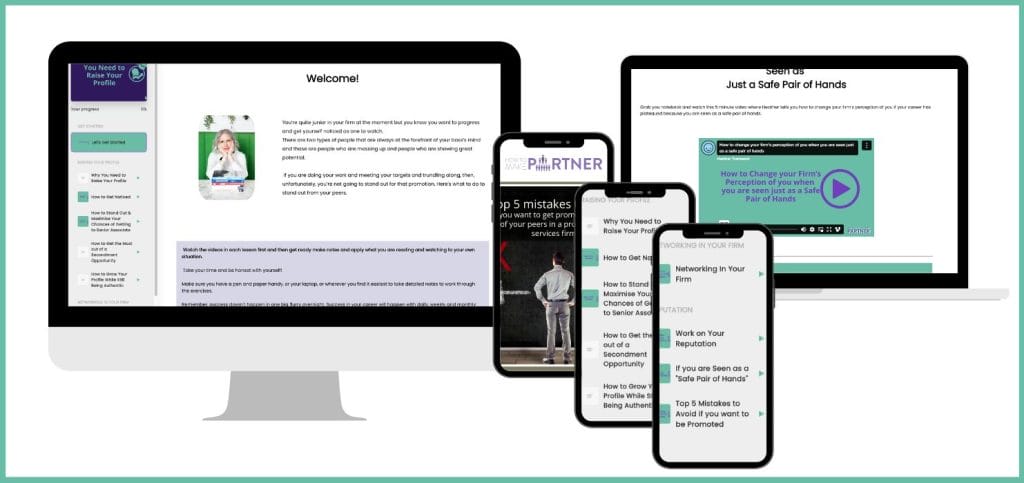
Join my Progress To Partner Academy and access all my courses and use the code PODCASTBP10 to get 10% off 12 months of premium annual membership.
______________________________________
More help to progress your career in your law, accountancy or consulting firm?
- Sign up to my weekly tips packed full of advice and knowledge on how to progress your career in your professional service firm – click here!


