


If a partner in your firm is retiring and you’re being lined up to take over their portfolio, it can feel like the route to partnership is clear. The clients are there. The revenue is there. All you have to do is step in.
But brokers who sell books of business factor in at least 20% client attrition when a portfolio changes hands. Clients are typically within ten years of the retiring partner’s age. And the practice you inherit may already have been drifting before you arrive.
In this episode, you’ll go through the six things you need to plan for. And understand why inheriting a portfolio gives you a starting point, not a Business Case.
In This Episode You Will Learn:
- Why brokers factor in at least 20% client attrition when a book of business changes hands, and what that means for the revenue picture in your Business Case
- The age proximity issue: why a retiring partner’s clients may already be winding down, not growing, and how to account for this in your three-year projections
- The six things your Business Case must address when it is built on an inherited portfolio, from client retention through to coming out from your predecessor’s shadow
- Why a Business Case built entirely on someone else’s relationships is fragile, and what your partners will need to see from you independently
If you find this episode useful, don’t forget to like it and then subscribe so you don’t miss another episode.
What Help Is Out There For You?
If you can see the challenges but aren’t sure how to build all of this into a Business Case your partners will back, our Progress To Partner Academy can help you.
That’s precisely why we have the on-demand course ‘How to Create a Cast-Iron Business Case for Partner’ in the Progress to Partner Academy. It walks you through how to build a Business Case on the inheritance premise — one that addresses the risks head on and shows your partners a credible path forward.
You can also listen to this episode on Substack and on Apple Podcasts
Hello, and welcome!
If a senior partner in your firm is retiring and you’re being lined up to take over their portfolio, you might be thinking: this is it. This is my route to partnership. The clients are there. The revenue is there. All I have to do is step in.
And in some ways, you’re right. Inheriting a partner’s portfolio is one of the more common routes to partnership. But it is far from the straightforward handover most people imagine.
Today, we’re going to look at the six things you need to plan for — including the one statistic that stops a lot of people in their tracks when they first hear it.
This is the How to Make Partner podcast with me, Heather Townsend. The author of Poised for Partnership, and co-author of How to Make Partner and Still Have a Life. In this podcast, I will be highlighting some of the great stuff in our Progress To Partner Academy. New episodes are released weekly, so press subscribe so you never miss a new episode.
Right, let’s talk about the reality of inheriting a partner’s portfolio — because there’s a version of this story that gets told, and a version that’s actually true.
The version that gets told is: a partner retires, their book of business passes to their successor, the revenue continues, and the new partner builds from there. Straightforward.
Here’s the reality. Brokers who sell books of business for accountants factor in that at least 20% of clients will leave when the book changes hands. At least. And that figure doesn’t account for the clients who don’t leave immediately but start looking around. The moment a client hears that their long-standing advisor is retiring, they have a reason to ask themselves whether they could be better served elsewhere. Some of them will act on it.
There’s a second factor that compounds this. Most advisors’ clients are within roughly ten years of their own age. So if a partner is retiring at 60, there is a good chance that a significant proportion of their clients are also approaching or already in retirement. Which means they’re winding down, not growing. Their service needs are likely to shrink over time, not expand. The revenue picture you’re inheriting may look better on paper than it will in reality within a few years.
And there’s a third thing. When a partner is approaching retirement, the incentive and energy to keep building the practice tends to reduce. Which means that by the time you step in, some clients may have already drifted away. Opportunities within the existing portfolio may have been missed. The practice you inherit may not be quite the same as the one on paper.
So what do you need to plan for? There are six things, and all of them need to show up in your Business Case.
First: how you will keep the profitable clients. Not all clients are equal. Some are long-standing, deeply loyal, and already work with you directly. Others barely know your name. Your Business Case needs to show that you understand which clients are at risk and what you will do to retain them. That means getting in front of key clients well before the handover, building the relationship directly, making sure the transition is gradual rather than sudden.
Second: how you will grow the existing portfolio. Retaining clients is the floor, not the ceiling. Your partners will want to see how you plan to deepen and grow the relationships you’re inheriting — cross-selling, expanding the scope of work, identifying opportunities the retiring partner may have missed or not had the energy to pursue.
Third: how you will find your own clients. This is the one people overlook when they’re focused on inheriting a retiring partners practice. A Business Case built entirely on someone else’s relationships is fragile. Your partners want to see that you can also originate work independently. That you have your own referral sources, your own market presence, your own pipeline. The inherited portfolio gives you a foundation. It shouldn’t be the whole argument.
Fourth: how you will streamline how things are done. Every practice has processes shaped by the habits and preferences of the person running it. When you take over, there is almost always an opportunity to improve how work gets delivered — more efficient resourcing, better systems, clearer processes. We looked at this in the episode on the profit margin, and it applies here too. Jessica is a good example of someone who made this the centrepiece of her year-one Business Case, and it was one of the factors that got her to partner.
Fifth: how you will manage the handover. This is a practical and a relationship question. A handover done badly — too fast, too abrupt, without proper client communication — accelerates client attrition. A handover done well, with the retiring partner making introductions, endorsing you personally, and stepping back gradually, gives clients the continuity they need to stay. Your Business Case should show that you’ve thought about this and have a plan.
Sixth, and this is the one that takes the longest: how you will come out from under the shadow of the partner you’ve taken over from. If clients have worked with this person for twenty years, they have a relationship with them, not with the firm. When that person leaves, you are not just a new face — you are a replacement for someone they trusted. Building your own identity, your own relationship, your own way of working with those clients takes time. Your Business Case needs to acknowledge this and show that you understand the longer journey involved.
Here’s the key message: inheriting a portfolio gives you a starting point. It does not give you a Business Case. The Business Case is what you build on top of it — your plan to retain what’s there, grow what’s there, add your own clients alongside it, and do all of that in a way that is profitable, sustainable, and distinctly yours.
Inheriting a partner’s portfolio is a route to partnership. It is not a guarantee of one. The clients are not yours yet. The revenue is not secure yet. And the practice you step into is not the same as the one you will be running in three years. Your Business Case needs to show that you understand all of that — and that you have a plan for it.
Now, if you’re thinking, ‘I can see the challenges, but I’m not sure how to build all of this into a Business Case that my partners will actually back,’ that’s exactly what our How to Create a Cast-Iron Business Case for Partner course is designed for. It walks you through how to build a Business Case on the inheritance premise — one that addresses the risks head on and shows your partners a credible path forward.
I’ve popped a link to our Progress To Partner Academy directly in the show notes for this episode. Also in the show notes, you’ll find links to my books — Poised for Partnership and How to Make Partner and Still Have a Life — so you can easily find them on Amazon. And as a thank you for listening, there’s also a link for a 10% discount on annual membership for our Progress To Partner Academy using the code PODCAST10.
That’s all for this episode of the How to Make Partner podcast. What’s your action for this week? If you’re planning to build your Business Case on an inherited portfolio, go through those six planning questions and write one sentence against each one. Not the full answer — just one sentence that shows you’ve thought about it. Where you can’t write even one sentence, that’s your gap.
If you have enjoyed this episode please leave us a review on Spotify or Apple Podcasts or give us a comment on Substack. This helps us get the word out to others who may need this advice too. Remember to hit subscribe so you don’t miss next week’s episode. Thanks for listening!
About Progress To Partner Academy: On-demand career help and guidance
You have to drive your career forwards. Your firm wouldn’t do that for you.
Stop waiting to be noticed for career development courses by your firm.
Make the firm notice you! You will get the skills and knowledge about what the partners are really looking for when you join our Progress to Partner Academy.
In our Progress To Partner Academy you’ll find our popular courses:
– How to delegate like a pro
– How to lead a hybrid team
– How to excel as a line manager
Join our Progress To Partner Academy and use the code PODCAST10 to get 10% off 12 months of premium annual membership.
Links
Complete my FREE Partnership Readiness Assessment – to see where you have gaps in your own development – you’ll get a personalised report with actions for what progress your career forward
Connect with me on LinkedIn
Join Progress To Partner Academy and use the code PODCAST10 to get 10% off 12 months of premium annual membership.
Buy your hard copy of Poised for Partnership or buy the Ebook here
Buy your copy of How To Make Partner And Still Have A Life
Buy your copy of The Go To Expert
Buy your copy of The Financial Times Guide To Business Networking
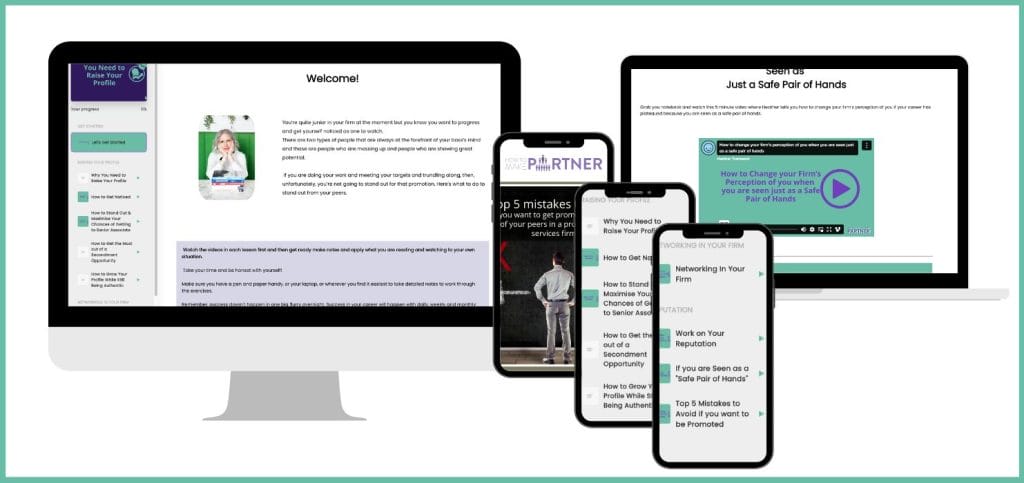
Join my Progress To Partner Academy and access all my courses and use the code PODCASTBP10 to get 10% off 12 months of premium annual membership.
______________________________________
More help to progress your career in your law, accountancy or consulting firm?
- Sign up to my weekly tips packed full of advice and knowledge on how to progress your career in your professional service firm – click here!


