


When someone asks how you’re going to grow your practice, most people’s answer is some version of: win more clients.
But winning more work is only one of five and a half ways to grow a practice. And it’s not always the highest-leverage one.
If your Business Case feels vague, e.g. lots of good intentions, not enough specifics, it’s often because you haven’t yet identified where your real growth levers are. This episode gives you a process-by-process framework to find them.
In this episode, you’ll go through all 5.5 processes in any practice, learn how to score each one, and identify the high-impact opportunities that belong in the narrative of your Business Case.
In This Episode You Will Learn:
- Why ‘win more work’ is only one of five and a half processes and why focusing on it exclusively often isn’t the way to grow a sustainable business
- The 5.5 processes framework: Create it, Convert it, Deliver it (client), Deliver it (people), Get paid for it, and Cultivate it — and the key diagnostic question for each one
- How to identify which processes are leaking in your practice, and how to separate high-impact opportunities from low-effort quick wins
If you find this episode useful, don’t forget to like it and then subscribe so you don’t miss another episode.
The 5.5 Processes at a Glance
Use this table as a reference when working through your own practice audit.
| Process | What it covers | Key questions to ask |
| Create it | Lead generation — getting potential clients into your pipeline | Am I generating enough leads to the right clients? Could I do it better or cheaper? |
| Convert it | Turning enquiries into signed-up clients | What is my conversion rate? Can I speed up the process or improve the rate? |
| Deliver it (client) | How work gets done and how clients experience it | Can I reduce write-offs? Improve expectation-setting? Use technology more? |
| Deliver it (people) | Team resource and delivery efficiency | Do I have the right skills in the team? Can I delegate more? Can I do less chargeable work? |
| Get paid for it | Pricing model and collections | Do I need to change how I charge? Can I reduce time to payment? Am I pricing correctly? |
| Cultivate it (½) | Growing existing client relationships | How do I get more from the clients I already have? Where are the cross-sell opportunities? |
What Help Is Out There For You?
If you’re thinking, ‘I can see where my practice needs work, but I’m not sure how to turn that into a Business Case and Business Plan that holds together,’ our Progress To Partner Academy can help you.
That’s precisely why we have the on-demand course ‘How to Create a Cast-Iron Business Case for Partner’ in the Progress to Partner Academy. It takes you through how to use process analysis to build the narrative and the numbers behind your Business Case — so it’s specific, evidenced, and something your partners can actually back.
You can also listen to this episode on Substack and on Apple Podcasts
Hello, and welcome!
When someone asks you how you’re going to grow your practice, what’s your first instinct? I’d be willing to bet it’s some version of: win more clients. Maybe get better at business development. Put myself out there more.
And those things matter. But they’re only one part of a much bigger picture. What you need is a sustainable practice, and there are 5.5 processes you now need to monitor. Not just ‘win more work’.
Today, we’re going to walk through all of them, so you can see exactly where your practice is leaking and where your real growth levers are.
This is the How to Make Partner podcast with me, Heather Townsend. The author of Poised for Partnership, and co-author of How to Make Partner and Still Have a Life.
In this podcast, I will be highlighting some of the great stuff in our Progress To Partner Academy. New episodes are released weekly, so press subscribe so you never miss a new episode.
Right, let’s look at what it actually takes to grow a practice. And I want to start with a reframe.
Your Business Case isn’t asking you to grow your practice. It’s asking you to grow a profitable and sustainable practice. That’s a different thing. It’s not just about revenue. It’s about how efficiently you generate that revenue, how reliably you can maintain it, and whether the whole thing works without you doing every bit of it yourself.
That’s why looking at your practice process by process is so useful. It moves you away from the vague sense that you need to ‘do more business development’ and towards a specific diagnosis: where exactly is the practice underperforming, and what would have the highest impact if you fixed it?
So let’s go through the 5.5 processes. And yes, it really is five and a half — the sixth one is slightly different in nature, which is why it gets the half. I’ll explain when we get to it.
Process one is Create it.
This is your lead generation — how you get potential clients into your pipeline in the first place. The questions to ask here are: am I generating enough leads to the right kind of clients? How much time is it taking to generate those leads? And could I do it better, simpler, or with less effort?
A lot of people have a Create it problem without realising it. Their pipeline isn’t dry because they’re bad at converting prospects — it’s dry because not enough prospects are arriving in the first place. If you’re working hard on business development but not seeing results, this is the first process to look at.
Process two is Convert it.
This is what happens between someone showing interest and signing up as a client. What is your conversion rate from enquiry to engaged client? How long does your sales process take? Could you speed it up? Could you improve the rate without spending more time on it?
A small improvement here can have a noticeable effect. If you’re converting 30% of enquiries and you move that to 40%, you’ve gained a third more clients without generating a single extra lead.
Process three is Deliver it — for the client.
This is how the work actually gets done and how the client experiences it. Can you improve how you deliver work? Could you set better expectations upfront and reduce the amount of time spent managing them? Can you reduce write-offs? Can you use technology to make delivery more efficient?
This process matters to your Business Case because it directly affects profitability. If you’re writing off 15% of your time on every piece of work, that’s not a delivery problem — it’s a profit problem.
Process 3.5 is Deliver it — for your people.
This is the team side of delivery. Do you have the right resource? Who or what skill set needs to develop so you can step back from chargeable work? Can you manage your team more efficiently, or deliver the work in a way that uses less of your own time? This is where the ‘half a process’ comes from.
Here’s the reality: your Business Case needs to show how your practice grows beyond you. If your revenue depends entirely on your own chargeable hours, there’s a ceiling — and it’s lower than you think. Process four is where you work out how to raise that ceiling.
Process four is Get paid for it.
This is your pricing model and your collections. Do you need to change how you charge? Move from time-based to fixed fees, for instance, or introduce payment on account? Can you reduce the time it takes to get paid? Are you leaving money on the table by not reviewing your prices regularly?
This one is often overlooked. Pricing is one of the highest-leverage levers in any practice. A 5% price increase on your current billing — with no extra work — goes straight to the bottom line.
And then Process five is Cultivate it.
This is your existing client relationships. How do you get more business from the clients you already have? How do you get closer to your key accounts so you can see where the opportunities are? How do you cross-sell the firm’s other services?
Cultivating a client well means you deliver better, convert follow-on work faster, get paid more reliably, and generate referrals that feed back into Create it. You could say, it’s woven through everything.
So how do you use this framework?
Here’s the key message: go through each process and score yourself honestly. Where is the work flowing well? Where is it slow, expensive, or unreliable? For each problem you identify, ask two questions: how much impact would fixing this have? And how much effort would it take?
You’re looking for the high-impact, lower-effort opportunities. Those are your critical moves — the things that go into the narrative of your Business Case. Not everything. The things that will actually shift the dial.
Growing a practice profitably and sustainably isn’t about doing one thing better. It’s about understanding which of the five and a half processes are working, which are leaking, and where the highest-impact opportunities are. That clarity is what turns a vague intention to ‘grow’ into a Business Case your partners can actually back.
Now, if you’re thinking, ‘I can see where my practice needs work, but I’m not sure how to turn that into a Business Case and Business Plan that holds together,’ that’s exactly what our How to Create a Cast-Iron Business Case for Partner course is designed for. It takes you through how to use this kind of process analysis to build the narrative and the numbers behind your Business Case.
I’ve popped a link to our Progress To Partner Academy directly in the show notes for this episode. Also in the show notes, you’ll find links to my books — Poised for Partnership and How to Make Partner and Still Have a Life — so you can easily find them on Amazon. And as a thank you for listening, there’s also a link for a 10% discount on annual membership for our Progress To Partner Academy using the code PODCAST10.
That’s all for this episode of the How to Make Partner podcast. What’s your action for this week? Take the 5.5 processes and score your practice against each one — honestly, not optimistically. Then identify one process where the impact of improving it would be high and the effort relatively low. That’s your critical move. Write it down.
If you have enjoyed this episode, please leave us a review on Spotify or Apple Podcasts or give us a comment on Substack. This helps us get the word out to others who may need this advice too.
Remember to hit subscribe so you don’t miss next week’s episode. Thanks for listening!
About Progress To Partner Academy: On-demand career help and guidance
You have to drive your career forwards. Your firm wouldn’t do that for you.
Stop waiting to be noticed for career development courses by your firm.
Make the firm notice you! You will get the skills and knowledge about what the partners are really looking for when you join our Progress to Partner Academy.
In our Progress To Partner Academy you’ll find our popular courses:
– How to delegate like a pro
– How to lead a hybrid team
– How to excel as a line manager
Join our Progress To Partner Academy and use the code PODCAST10 to get 10% off 12 months of premium annual membership.
Links
Complete my FREE Partnership Readiness Assessment – to see where you have gaps in your own development – you’ll get a personalised report with actions for what progress your career forward
Connect with me on LinkedIn
Join Progress To Partner Academy and use the code PODCAST10 to get 10% off 12 months of premium annual membership.
Buy your hard copy of Poised for Partnership or buy the Ebook here
Buy your copy of How To Make Partner And Still Have A Life
Buy your copy of The Go To Expert
Buy your copy of The Financial Times Guide To Business Networking
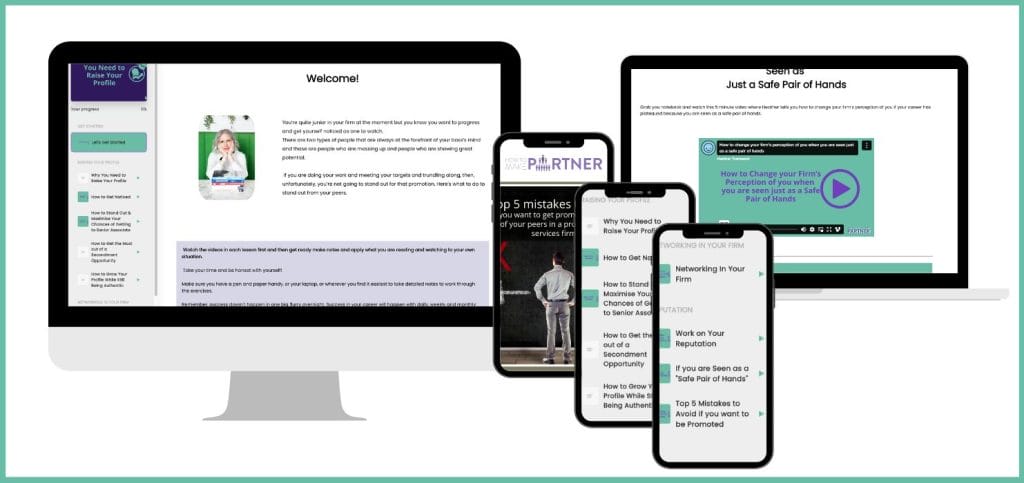
Join my Progress To Partner Academy and access all my courses and use the code PODCASTBP10 to get 10% off 12 months of premium annual membership.
______________________________________
More help to progress your career in your law, accountancy or consulting firm?
- Sign up to my weekly tips packed full of advice and knowledge on how to progress your career in your professional service firm – click here!


