


When my team reviews a client’s Business Case for the first time, we almost always find at least one of the same mistakes. Some are fixable with a few hours of rewriting. Others can’t be fixed in the document at all because they’re not document problems. They’re practice problems.
In this episode, we go through all seven; what each one looks like, which category it falls into, and what to do about it. The audit at the end is more useful than another hour of writing.
In This Episode You Will Learn:
- The seven most common Business Case mistakes
- Why talking about your technical skills in your Business Case works against you, and what to replace that content with
- What Jay’s conversation with equity partners revealed about the difference between planning to build referral networks and already having ones that work
- How to do a writing problem vs practice problem audit on your own Business Case, and why that distinction changes everything about what you do next
If you find this episode useful, don’t forget to like it and then subscribe so you don’t miss another episode.
What Help Is Out There For You?
If you’ve spotted the problems but aren’t confident you know how to fix them — especially the practice ones — our Progress To Partner Academy can help you.
That’s precisely why we have the on-demand course ‘How to Create a Cast-Iron Business Case for Partner’ in the Progress to Partner Academy. It takes you through building a Business Case that is specific, evidenced, commercially grounded, and confident — with no gaps for your partners to find.
You can also listen to this episode on Substack and on Apple Podcasts
Hello, and welcome!
When my team reviews a client’s Business Case for the first time, we almost always find at least one of the same mistakes. Usually more than one. And the frustrating thing is that some of them are easy to fix — a few hours of rewriting and they’re gone. But some of them can’t be fixed in the document at all, because they’re not document problems. They’re practice problems. And those take months, sometimes years, to address.
Today we’re going through all seven. So you can see which ones you’re making, and more importantly — which category they fall into.
This is the How to Make Partner podcast with me, Heather Townsend. The author of Poised for Partnership, and co-author of How to Make Partner and Still Have a Life. In this podcast, I will be highlighting some of the great stuff in our Progress To Partner Academy. New episodes are released weekly, so press subscribe so you never miss a new episode.
Right, let’s go through the seven mistakes. I’m going to give you the pattern for each one — what it looks like in the document — and then tell you whether it’s a writing problem or a practice problem, because that changes what you do about it.
Mistake number one: too focused on technical ability.
This one shows up as a Business Case that spends a lot of time on qualifications, expertise, client satisfaction, quality of work. All of which matters — but none of which is the point. By the time you’re being considered for partner, your technical ability is taken as a given. Your partners are not asking whether you can do the work. They’re asking whether you can build and grow a profitable practice. Those are different questions, and your Business Case needs to answer the second one.
This is a writing problem. You can fix it by going through your Business Case and asking, for every paragraph: is this about my technical skills, or is it about the commercial opportunity? If it’s the former, cut it or reframe it.
Mistake number two: not enough evidence.
This is one of the most common. It shows up as a Business Case full of good intentions — ‘I plan to’, ‘I intend to’, ‘I hope to build’ — but without the evidence that those intentions are grounded in reality. Your partners are doing due diligence on a potential investment. They want to see that your Business Case is already happening, not just that you’ve thought about it.
I worked with a client called Jay who discovered this directly. After conversations with equity partners in his firm, he found out that he didn’t need a full partner-sized client portfolio to get recommended. But he did need to show that his referral networks were already generating profitable new business for the firm. Not that he planned to build them. That they were already working. The evidence had to already exist.
This can be a writing problem or a practice problem, depending on what’s actually there. If the evidence exists but isn’t in the document, that’s a writing fix. If the evidence doesn’t yet exist, that’s a practice problem — and it tells you exactly what to go and build.
Mistake number three: not specific enough.
A Business Case that says ‘I will grow my client base in the technology sector’ is not a Business Case. It’s a vague intention. Your partners want to read your Business Case and know exactly what you are going to do. That means named clients you plan to grow. Named introducers in your referral network. Specific markets and why you’ve chosen them. Specific targets they can hold you to.
Vague statements signal one of two things: either you haven’t thought it through, or you don’t yet have the relationships and activity to be specific. The first is a writing problem. The second is a practice problem.
Mistake number four: not confident enough.
In your day job, you manage risk. You help clients understand what could go wrong. You qualify your advice. And those habits can bleed into your Business Case if you’re not careful — turning it into a document full of ‘hopefully’, ‘possibly’, ‘I hope to achieve’, and ‘subject to market conditions’.
In Poised for Partnership, I talk about what Susan Heaton-Wright calls Ding Dong words — the words and phrases that quietly drain the authority out of everything you say. Your Business Case cannot have them. Not one. Read it back and remove every ‘hopefully’. Every ‘I think’. Every ‘if all goes well’. Replace them with direct statements. This is a writing problem, and it’s fixable in an afternoon.
Mistake number five: assuming growth only comes from winning more work.
We covered this in depth in a recent episode, so I’ll keep this brief. A Business Case that is entirely focused on winning new clients tells your partners you haven’t thought about margin, efficiency, resourcing, or sustainability. They want to see commercial thinking. Show them you understand that a profitable practice grows in more ways than one. Writing problem — fix it by broadening what your Business Case covers.
Mistake number six: assuming time is infinite.
This one is subtle but the partners will spot it. It shows up as revenue projections that keep climbing year on year with no explanation of how you’ll actually service all that work. If you’re already close to capacity, where is the time coming from? Your Business Case needs to show how the practice grows beyond your own hours — the team you’ll build, the resource you’ll bring in, the systems you’ll put in place to make delivery scalable.
If you don’t address this, your partners will do the maths themselves and ask the question in the panel interview. Better to have the answer already in the document. Writing problem, mostly — though if you genuinely haven’t thought through the resourcing, that’s a practice problem underneath it.
Mistake number seven: not answering the ‘Why me, why now’ questions.
We covered this in detail in a recent episode too, so again I’ll keep it brief. But it’s on this list because it’s the gap I see in almost every first draft. A Business Case that describes a strong opportunity but doesn’t explicitly answer ‘Why should it be me who implements this?’ and ‘Why should my partners back this now?’ has a hole at its centre. Your partners will feel it, even if they can’t immediately name it. Writing problem. Fix it.
Here’s the key message: before you do anything else with your Business Case, go through these seven mistakes and do an honest audit. Which ones are you making? And for each one — is it a writing problem you can fix this week, or a practice problem that tells you what you need to go and build?
That audit is more useful than another hour of writing.
Seven mistakes. Some are in the writing and can be fixed quickly. Others are in the practice — the evidence that isn’t there yet, the referral networks not yet built, the resourcing not yet thought through. Knowing which you’re facing is the most useful thing you can do right now.
Now, if you’re thinking, ‘I’ve spotted the problems, but I’m not confident I know how to fix them — especially the practice ones,’ that’s exactly what our How to Create a Cast-Iron Business Case for Partner course is designed for. It takes you through building a Business Case that is specific, evidenced, commercially grounded, and confident — with no gaps for your partners to find.
I’ve popped a link to our Progress To Partner Academy directly in the show notes for this episode. Also in the show notes, you’ll find links to my books — Poised for Partnership and How to Make Partner and Still Have a Life — so you can easily find them on Amazon. And as a thank you for listening, there’s also a link for a 10% discount on annual membership for our Progress To Partner Academy using the code PODCAST10.
That’s all for this episode of the How to Make Partner podcast. What’s your action for this week? Print out your Business Case — or your notes towards one — and go through it against these seven mistakes. For each one you find, write next to it: writing problem or practice problem. The writing problems, fix this week. The practice problems, put them on your development plan. That’s the most honest audit you can do.
If you have enjoyed this episode please leave us a review on Spotify or Apple Podcasts or give us a comment on Substack. This helps us get the word out to others who may need this advice too.
Remember to hit subscribe so you don’t miss next week’s episode. Thanks for listening!
About Progress To Partner Academy: On-demand career help and guidance
You have to drive your career forwards. Your firm wouldn’t do that for you.
Stop waiting to be noticed for career development courses by your firm.
Make the firm notice you! You will get the skills and knowledge about what the partners are really looking for when you join our Progress to Partner Academy.
In our Progress To Partner Academy you’ll find our popular courses:
– How to delegate like a pro
– How to lead a hybrid team
– How to excel as a line manager
Join our Progress To Partner Academy and use the code PODCAST10 to get 10% off 12 months of premium annual membership.
Links
Complete my FREE Partnership Readiness Assessment – to see where you have gaps in your own development – you’ll get a personalised report with actions for what progress your career forward
Connect with me on LinkedIn
Join Progress To Partner Academy and use the code PODCAST10 to get 10% off 12 months of premium annual membership.
Buy your hard copy of Poised for Partnership or buy the Ebook here
Buy your copy of How To Make Partner And Still Have A Life
Buy your copy of The Go To Expert
Buy your copy of The Financial Times Guide To Business Networking
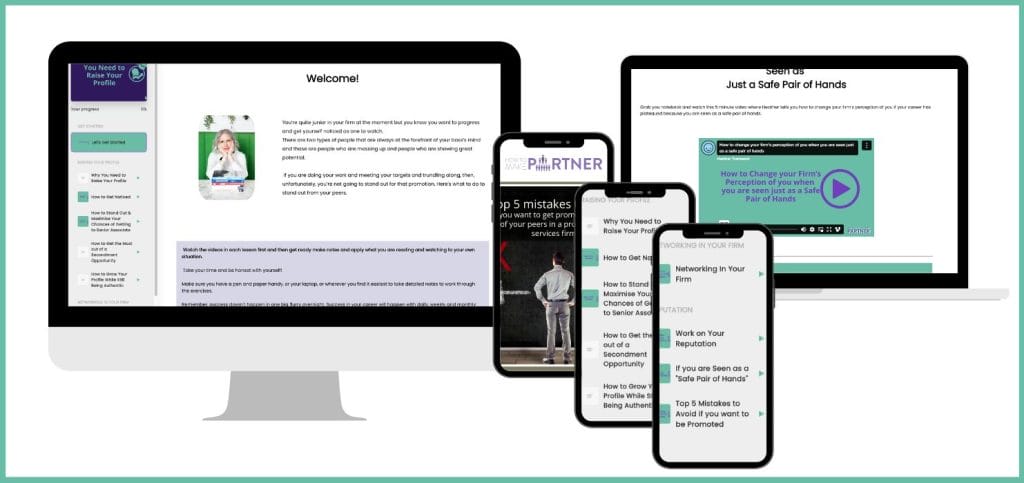
Join my Progress To Partner Academy and access all my courses and use the code PODCASTBP10 to get 10% off 12 months of premium annual membership.
______________________________________
More help to progress your career in your law, accountancy or consulting firm?
- Sign up to my weekly tips packed full of advice and knowledge on how to progress your career in your professional service firm – click here!


