


Have you ever had a partner read your Business Case and ask: “But why should it be you? And why now?”
That can feel deflating. Especially when you’ve spent years building your practice and the answer feels obvious to you. But here’s the truth: the vast majority of Business Cases never answer those two questions explicitly. And partners feel that gap, even when they can’t immediately articulate what’s missing.
In this episode, you’ll discover exactly how to build your answers to both questions; with the evidence that makes a partnership say yes.
In This Episode You Will Learn:
- Why your technical skills and track record are the wrong answer to the ‘Why Me’ question. And what your partners are actually looking for instead
- How Jem, a sales director already winning hundreds of millions in client business, transformed his partnership pitch by answering these two questions, and was told it was the best pitch his firm had ever seen
- The four types of evidence that make a strong ‘Why Me’ answer.
- The three ‘Why Now’ arguments, and how to identify which one applies to your situation right now
If you find this episode useful, don’t forget to like it and then subscribe so you don’t miss another episode.
What Help Is Out There For You?
If you’re thinking, ‘I get the concept, but I’m not sure how to build my full Business Case into a document that actually lands,’ our Progress To Partner Academy can help you.
That’s precisely why we have the on-demand course ‘How to Create a Cast-Iron Business Case for Partner’ in the Progress to Partner Academy. It takes you step by step through building your Business Case and Business Plan using the STAGe model, including how to develop and evidence your ‘Why Me’ and ‘Why Now’ arguments so they are specific and hard to argue with.ecifically what to work on helps close the confidence gap.
You can also listen to this episode on Substack and on Apple Podcasts
Hello, and welcome!
Have you ever had a partner read your Business Case, nod along, and then say — “This is all really good. But why should it be you who does this? And why now?”
That question can feel deflating, especially after everything you’ve put into building your practice. But here’s the thing: it’s the most important question your Business Case needs to answer. And the vast majority of Business Cases I see never answer it at all.
Today, we’re going to fix that.
This is the How to Make Partner podcast with me, Heather Townsend. The author of Poised for Partnership, and co-author of How to Make Partner and Still Have a Life. In this podcast, I will be highlighting some of the great stuff in our Progress To Partner Academy. New episodes are released weekly, so press subscribe so you never miss a new episode.
Right, let’s talk about the two questions that sit at the heart of every successful Business Case.
When a partnership considers making someone up to partner, they’re not just evaluating the opportunity. They’re evaluating you. And there are two very specific questions every partnership asks about every candidate. The first: why should it be this person who implements this Business Case? And the second: why should we make them up to partner to do it now, this time around?
Those two questions have to be answered explicitly in your Business Case. Not implied. Not assumed. Answered. And here’s the truth — most people never do it.
Why not? Because when you’ve spent years building your practice, the answers feel obvious to you. You know why it should be you. You know why the timing is right. So you write your Business Case around the opportunity — the gap in the market, the growing client base, the retiring partner’s portfolio — and you assume your partners will join the dots.
They won’t. Or at least — they shouldn’t have to.
Think about it this way. Partnership decisions are rarely made by the one person who knows you best. They’re made by a group of partners, some of whom know you well and some of whom barely know you at all. Your Business Case needs to make the argument clearly enough that the partners who do back you can use it to advocate for you in a room where you’re not present.
Your Business Case isn’t a document for the people who already support you. It’s a tool for them to use to persuade the people who don’t.
Let me share a story that illustrates exactly why this matters. I worked with someone called Jem, who was a director of sales at a large US consultancy firm. He had a strong track record — he’d helped the firm sign clients worth hundreds of millions of dollars.
And yet when he came to me to prepare his pitch for partnership, we hit a wall. Because the question I put to him was: “Why should your firm make you up to partner?”
Think about that for a moment. Without the partner title, Jem was already winning large pieces of business. So what would actually change if he became a partner? What would the firm gain that they didn’t currently have? And critically — why did it need to happen now?
We spent a good amount of time working through those answers. Not the opportunity — that was already obvious to everyone. But why Jem specifically, and why at this point in the firm’s development. The result? He made partner. The chairman of his firm told him it was the best pitch for partnership they had ever seen.
That’s what answering these two questions properly can do.
So let’s look at each question in turn.
First: Why Me?
This is where many people make a critical mistake. They answer the ‘Why Me’ question by talking about their technical skills and their track record. The quality of their client work. How long they’ve been with the firm. How hard they’ve worked.
But here’s the problem. By the time you’re being considered for partner, your technical competence is taken as a given. Your partners aren’t asking whether you can do the work. They’re asking whether you are the best-placed person to build and grow this specific practice. And those are very different questions.
A strong ‘Why Me’ answer is specific. It’s evidenced. And it makes clear that the opportunity would be harder — or impossible — to seize without you. For example:
You have deep relationships within a specific client or sector that the firm wants to grow — and those relationships are with you personally, not with the firm brand.
You have a referral network that is already sending profitable work to the firm. Not that you plan to build one. That you already have one, and it’s already working.
You’ve been building your expertise and profile in a new market for two years. Starting again with someone else would cost the firm time it doesn’t have.
You’re the natural successor to a retiring partner, and crucially, the clients already work with you, already trust you, and the transition is already underway.
Notice what all of these have in common. They’re not about being good. They’re about being irreplaceable for this particular opportunity at this particular moment. That’s the standard you’re aiming for with your ‘Why Me’ answer.
Now, the second question: Why Now?
Even if your partners accept that you’re the right person, they still need to understand why this needs to happen at this point in time rather than in twelve or eighteen months. Particularly if your firm is going through a ‘lean’ patch financially.
The most compelling ‘Why Now’ answers usually come in one of three forms. The first is external pressure. A regulatory change, a market shift, a competitor move, a client whose demands are growing faster than your current capacity to respond. If you don’t move now, someone else will — inside or outside the firm.
The second is internal pressure. A partner is retiring. There’s a gap in leadership that is already visible and already costing the firm clients or opportunities.
The third is more personal. You have reached a moment in your career where you can demonstrably do things now that you couldn’t have done eighteen months ago. Your referral networks have reached the point where they can sustain a partner-level practice. Your client base has grown to a threshold where it’s at risk if you’re not given the autonomy that comes with partnership.
Any one of these can be a compelling ‘Why Now’. But the key is to make it explicit. Write it out. Don’t leave your partners to infer it.
And here’s the key message: the partnership is not just backing your Business Case. They’re backing you, at this specific moment in time, to deliver it. Make sure your document makes that case.
A Business Case that describes a strong opportunity, but doesn’t answer ‘Why Me’ and ‘Why Now’, has a gap at its centre. Your partners will feel that gap, even if they can’t immediately put their finger on what’s missing. So close the gap. Make the argument explicit. Give the partners who are already in your corner the tools to advocate for you when you’re not in the room.
Now, if you’re thinking, “I get the concept, but I’m not sure my answers are strong enough yet — or I don’t know how to structure all of this into a document that actually lands,” that’s exactly what our How to Create a Cast-Iron Business Case for Partner course is designed for. It takes you step by step through building your Business Case using the STAGe model, including how to construct and evidence your ‘Why Me’ and ‘Why Now’ arguments so they are specific and hard to argue with.
I’ve popped a link to our How to Create a Cast-Iron Business Case for Partner course and our Progress To Partner Academy directly in the show notes for this episode. Also in the show notes, you’ll find links to my books — Poised for Partnership and How to Make Partner and Still Have a Life — so you can easily find them on Amazon. And as a thank you for listening, there’s also a link for a 10% discount on annual membership for our Progress To Partner Academy using the code PODCAST10.
That’s all for this episode of the How to Make Partner podcast.
What’s your action for this week? Pull out your current Business Case — or your notes towards one — and find the paragraph where you explicitly answer the question ‘Why should it be me?’ If you can’t find it, that’s your task this week.
Write two or three sentences. Specific evidence, not general qualities. That’s where the persuasive power of your Business Case lives.
If you have enjoyed this episode please leave us a review on Spotify or Apple Podcasts or give us a comment on Substack. This helps us get the word out to others who may need this advice too. Remember to hit subscribe so you don’t miss next week’s episode.
Thanks for listening!
About Progress To Partner Academy: On-demand career help and guidance
You have to drive your career forwards. Your firm wouldn’t do that for you.
Stop waiting to be noticed for career development courses by your firm.
Make the firm notice you! You will get the skills and knowledge about what the partners are really looking for when you join our Progress to Partner Academy.
In our Progress To Partner Academy you’ll find our popular courses:
– How to delegate like a pro
– How to lead a hybrid team
– How to excel as a line manager
Join our Progress To Partner Academy and use the code PODCAST10 to get 10% off 12 months of premium annual membership.
Links
Complete my FREE Partnership Readiness Assessment – to see where you have gaps in your own development – you’ll get a personalised report with actions for what progress your career forward
Connect with me on LinkedIn
Join Progress To Partner Academy and use the code PODCAST10 to get 10% off 12 months of premium annual membership.
Buy your hard copy of Poised for Partnership or buy the Ebook here
Buy your copy of How To Make Partner And Still Have A Life
Buy your copy of The Go To Expert
Buy your copy of The Financial Times Guide To Business Networking
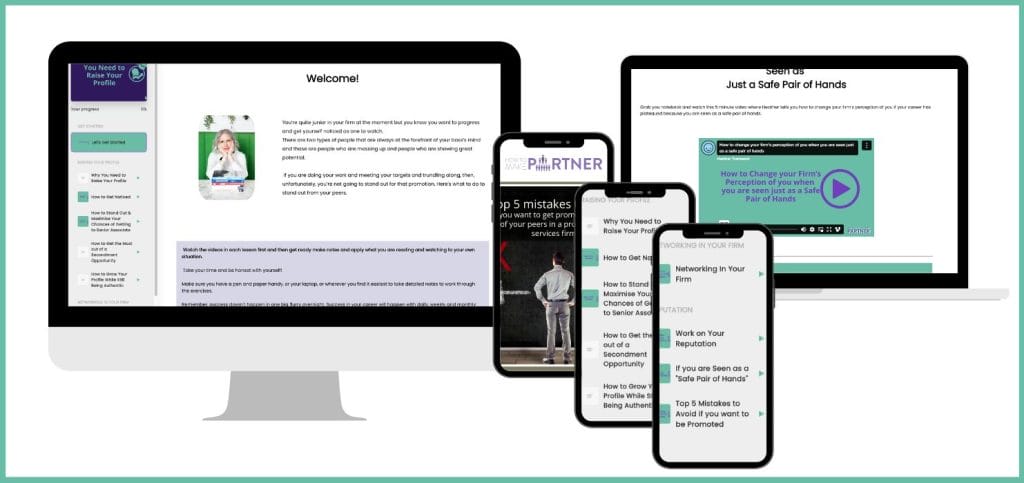
Join my Progress To Partner Academy and access all my courses and use the code PODCASTBP10 to get 10% off 12 months of premium annual membership.
______________________________________
More help to progress your career in your law, accountancy or consulting firm?
- Sign up to my weekly tips packed full of advice and knowledge on how to progress your career in your professional service firm – click here!


