


Most people treat their Business Case like a document they’ll write when the time comes. A weekend project. Something to sort out when they’re close enough to partnership to need it.
Here’s the truth: by the time you sit down to write it, it’s too late to build it. Your Business Case isn’t a document you produce; it’s a practice you grow over years. And our Partnership Readiness Assessment shows that only 29% of ambitious professionals have been actively working on theirs for one to three years with stakeholder backing already in place.
In this episode, you’ll find out what a Business Case actually is, which of the six premises yours sits on, and what you need to be doing right now, whatever stage you’re at.
In This Episode You Will Learn:
- Why a Business Case is something you grow over years, not something you write over a weekend, and why most people start far too late
- The six premises that Business Cases are built on, and how to identify which one applies to your situation right now
- Why a well-organised partnership is already thinking about where the Business Case for a new partner lies, years before any candidate is formally considered
If you find this episode useful, don’t forget to like it and then subscribe so you don’t miss another episode.
What Help Is Out There For You?
If you’re thinking, ‘I understand what a Business Case is, but I’m not sure how to build mine from where I am right now — or how to get it into a format my partners will actually back,’ our Progress To Partner Academy can help you.
That’s precisely why we have the on-demand course ‘How to Create a Cast-Iron Business Case for Partner’ in the Progress to Partner Academy. It takes you through the whole process, from identifying your premise to building out your Business Plan using the STAGe model, and shows you how to pitch it in a way that lands.
You can also listen to this episode on Substack and on Apple Podcasts
Hello, and welcome!
Have you ever thought: I’ll put my Business Case together when I need it? Maybe over a long weekend. Get it written up, present it to the partners, and take it from there.
If that’s your plan, I have some news for you. And it’s not the news you probably want to hear.
Your Business Case isn’t something you write. It’s something you grow. And the growing takes years, not weeks. Today, we’re going to look at what that actually means — and what you need to be doing right now, whatever stage you’re at with your career and Business Case.
This is the How to Make Partner podcast with me, Heather Townsend. The author of Poised for Partnership, and co-author of How to Make Partner and Still Have a Life. In this podcast, I will be highlighting some of the great stuff in our Progress To Partner Academy. New episodes are released weekly, so press subscribe so you never miss a new episode.
Right, let’s talk about what a Business Case actually is — because I think there’s a widespread misunderstanding about this, and it’s costing people years in terms of taking the step up to partner.
Here’s how most people think about their Business Case. They think of it as a document. A Business Plan they’ll put together at some point in the future, when they’re close to being considered for partner. They’ll gather their numbers, write up their plans, present it to the right people, and that’s that.
Here’s the reality. The document is the last step, not the first. Before you can write a Business Case that your partners will back, you need to have already built the practice the Business Case describes. The clients, the referral networks, the track record, the market positioning — all of it needs to exist before you sit down to write a single word. Which is why building a Business Case typically takes years.
Our Partnership Readiness Assessment bears this out. Only 29% of ambitious professionals have been actively working on their Business Case for one to three years and have the backing of key stakeholders already in place. That means the majority are either not working on it yet, or working on it without the internal support they need. Both of those are problems.
So the first change I want you to make is this: stop thinking of your Business Case as something you will write, and start thinking of it as something you are building. Every client relationship you deepen, every referral source you cultivate, every piece of work you win independently — that’s your Business Case taking shape. The document just captures what’s already there.
Now, before you can build your Business Case, you need to know what it’s built on. And there are six common premises that Business Cases are built on. Understanding which one applies to you is the starting point for everything else.
Premise one
A partner is retiring and the department needs a replacement. This is one of the more common routes. But, the key point is that stepping into a retiring partner’s shoes is not the same as inheriting their clients. You still need to show how you will sustain and grow that practice.
Premise two
A part of the firm is growing and needs another partner to help service it. Here your Business Case is about demonstrating that you are the right person to take on that expanded responsibility — and that the growth is real and sustainable, not just a good run. Or, for example, a change in legislation or government initiative that is creating a ‘bubble’ of work. Ideally the firm has agreed in its strategy to support the growth of your part of the firm AND has identified a business case for someone like you 3-5 years before the partner role is needed.
Premise three
You have personally built a partner-sized client portfolio that the firm cannot afford to lose. This feels like a strong position to be in. Your Business Case here is about demonstrating the value of what you’ve already built, and showing how you will protect and grow it with partnership behind you. However… what you think is a strong position may not be what your partners think is a strong position. After all, if you have built this practice as a non-partner, why do they need to share equity with you as a partner? And more importantly do your partners think that they can’t afford to lose you and your client portfolio.
After all, if you were to resign tomorrow most firms – where employment law allows – will put you on gardening leave and enforce your restrictive covenants. That could give your firm potentially 6-12 months to backfill you and defend your client portfolio.
Premise four
You have a strong network of trusted contacts that you can use to open doors for other partners in the firm. This one is less about your own clients and more about your ability to create opportunities for the wider partnership. The evidence here is in the referrals you’ve already generated, not just the ones you’re promising. This is a fairly rare type of business case and often is used for a lateral hire.
Premise five
You have deep relationships within a specific client that the firm wants to grow. Your Business Case is about demonstrating how central you are to that relationship, and what the firm stands to gain from investing in your progression.
Premise six
There is an opportunity to enter a new market or offer a new service that you can build into a profitable practice — and you need partner on your business card to make it happen. This typically requires your firm to have agreed upon the strategy to enter into the new market or new service. It’s not something that they do on a whim.
Here’s the key message: a well-organised partnership is already thinking about where the Business Case for a new partner lies, often years before any candidate is formally considered. They will work with a selection of people to build towards it. Which means if you don’t know which premise your Business Case sits on, there’s a good chance the partners do — and they’re watching to see whether you’re building towards it or not.
So the question to ask yourself today is: which of those six premises is mine? Not which one I’d like it to be. Which one is it, based on the practice I’m actually building right now?
If you can answer that clearly, you have your direction. If you can’t, that’s your starting point and its time to book time to speak to the key partners in your office, region and service line.
Your Business Case is not a document you produce under pressure. It’s a practice you build deliberately, over time, on one of six clear premises. The earlier you know which premise is yours, and the earlier you start building towards it, the stronger your position when the moment comes.
Now, if you’re thinking, ‘I understand the idea, but I’m not sure how to actually build my Business Case from where I am right now — or how to get it into a format my partners will back,’ that’s exactly what our How to Create a Cast-Iron Business Case for Partner course is designed for. It walks you through the whole process, from identifying your premise to building out your Business Plan using the STAGe model, and shows you how to pitch it in a way that lands.
I’ve popped a link to our Progress To Partner Academy directly in the show notes for this episode. Also in the show notes, you’ll find links to my books — Poised for Partnership and How to Make Partner and Still Have a Life — so you can easily find them on Amazon. And as a thank you for listening, there’s also a link for a 10% discount on annual membership for our Progress To Partner Academy using the code PODCAST10.
That’s all for this episode of the How to Make Partner podcast.
What’s your action for this week? Look at those six Business Case premises and identify which one applies to you. Write it down.
Then ask yourself: what have I actually done in the last three months to build towards it? If the answer is ‘not much,’ you know what needs to change.
If you have enjoyed this episode please leave us a review on Spotify or Apple Podcasts or give us a comment on Substack. This helps us get the word out to others who may need this advice too. Remember to hit subscribe so you don’t miss next week’s episode.
Thanks for listening!
About Progress To Partner Academy: On-demand career help and guidance
You have to drive your career forwards. Your firm wouldn’t do that for you.
Stop waiting to be noticed for career development courses by your firm.
Make the firm notice you! You will get the skills and knowledge about what the partners are really looking for when you join our Progress to Partner Academy.
In our Progress To Partner Academy you’ll find our popular courses:
– How to delegate like a pro
– How to lead a hybrid team
– How to excel as a line manager
Join our Progress To Partner Academy and use the code PODCAST10 to get 10% off 12 months of premium annual membership.
Links
Complete my FREE Partnership Readiness Assessment – to see where you have gaps in your own development – you’ll get a personalised report with actions for what progress your career forward
Connect with me on LinkedIn
Join Progress To Partner Academy and use the code PODCAST10 to get 10% off 12 months of premium annual membership.
Buy your hard copy of Poised for Partnership or buy the Ebook here
Buy your copy of How To Make Partner And Still Have A Life
Buy your copy of The Go To Expert
Buy your copy of The Financial Times Guide To Business Networking
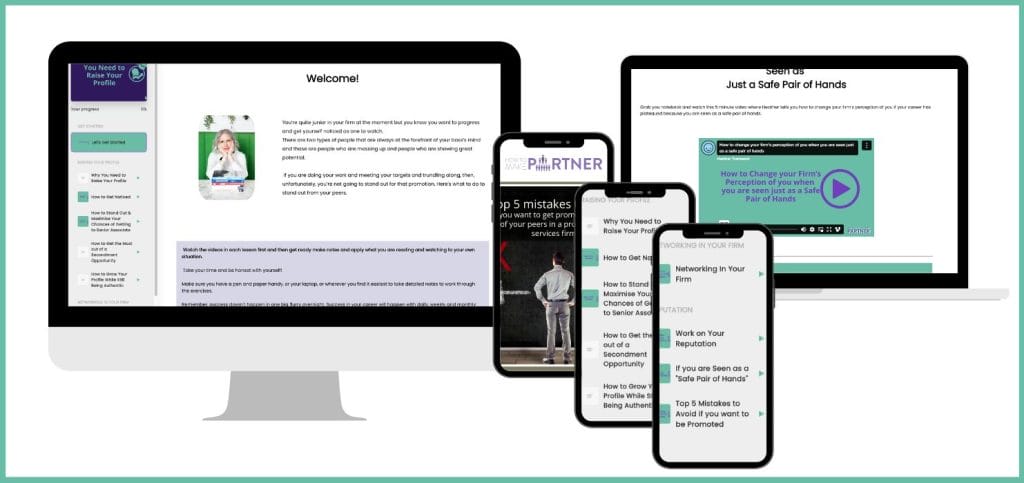
Join my Progress To Partner Academy and access all my courses and use the code PODCASTBP10 to get 10% off 12 months of premium annual membership.
______________________________________
More help to progress your career in your law, accountancy or consulting firm?
- Sign up to my weekly tips packed full of advice and knowledge on how to progress your career in your professional service firm – click here!


